


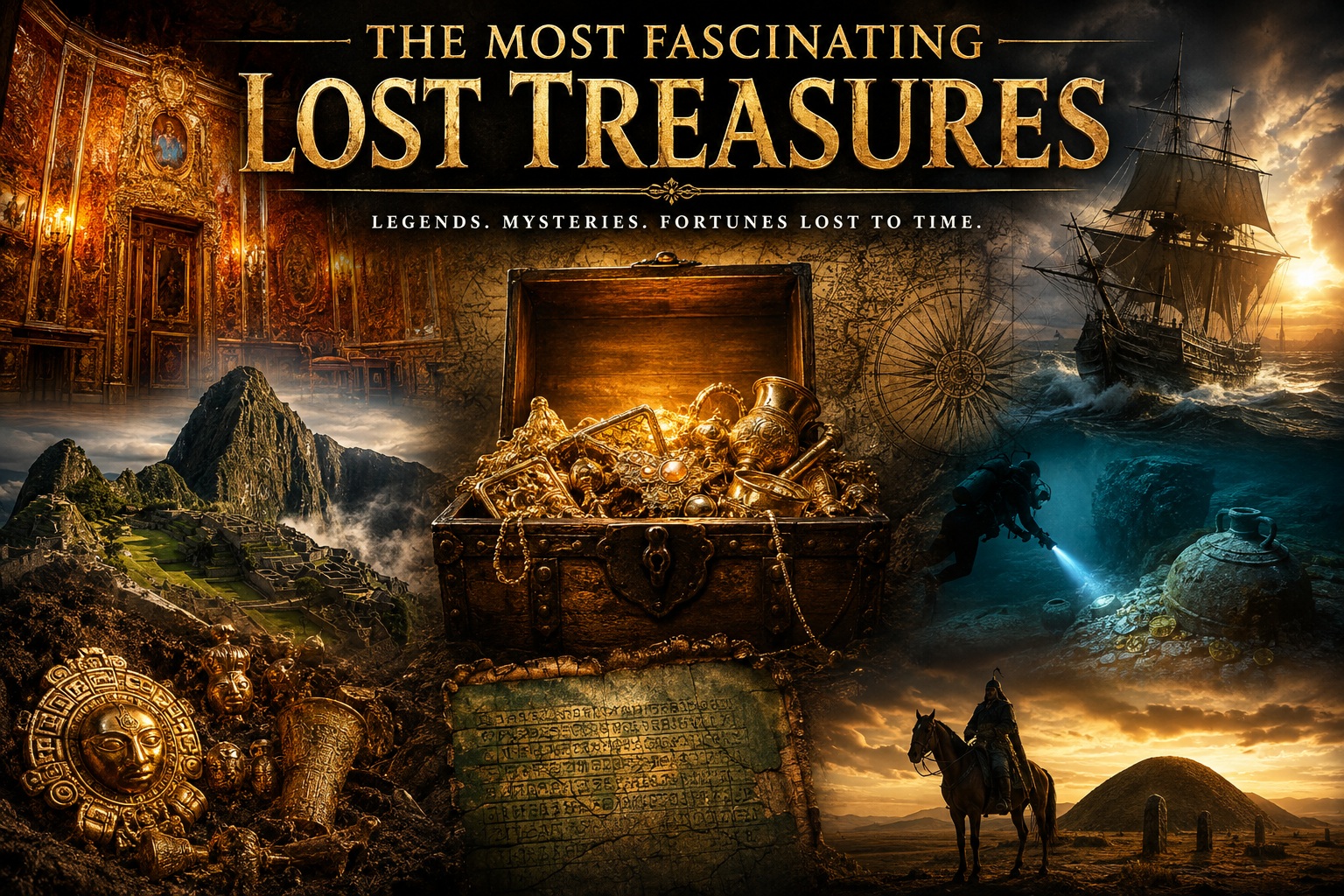
Thanks to Historical Insights for this:
Throughout history, countless fortunes have disappeared beneath the sea, vanished into remote mountains, or been hidden during times of war and never recovered. While many legendary treasures have become the subject of folklore, others are well documented historical mysteries that continue to captivate archaeologists, historians, and treasure hunters alike. Some are likely still waiting to be discovered, while others may have been destroyed or dispersed long ago.
List of the most fascinating lost treasures ever recorded:
1. The Amber Room ⭐⭐⭐⭐⭐
Date Created: Early 1700s
Disappeared: 1945
Origin: Prussia (modern Germany)
Last Confirmed Location: Königsberg Castle (now Kaliningrad, Russia)
Estimated Value: More than $500 million
Often called the greatest missing work of art in history, the Amber Room was one of Europe’s most spectacular royal treasures. Constructed from more than six tons of Baltic amber and adorned with gold leaf, mirrors, and intricate Baroque carvings, the room was considered the “Eighth Wonder of the World.”
During World War II, German forces dismantled the room in 1941, packed it into 27 crates, and transported it to Königsberg Castle. As Nazi Germany collapsed in 1945, the Amber Room disappeared without a trace. Despite decades of searches, no definitive evidence has revealed whether it was destroyed, hidden, or still survives somewhere.
2. Flor de la Mar ⭐⭐⭐⭐⭐
Date Lost: 1511
Location: Strait of Malacca near Sumatra, Indonesia
Estimated Value: Approximately $2.6 billion
The Portuguese carrack Flor de la Mar may represent the greatest undiscovered shipwreck treasure on Earth.
After Portugal conquered the wealthy trading city of Malacca, the ship was loaded with enormous quantities of gold, gemstones, royal treasures, and precious metalwork. Before it could return to Portugal, the heavily laden vessel struck a reef in the Strait of Malacca and sank.
Political disagreements between Indonesia, Malaysia, and Portugal have complicated exploration of the wreck site for decades, leaving one of history’s richest cargoes unrecovered.
3. The Copper Scroll Treasure ⭐⭐⭐⭐⭐
Date Hidden: Around 68 CE
Location: Judaean Desert (modern Israel and the West Bank)
Estimated Value: Approximately $1.2 billion (speculative)
The Copper Scroll is arguably the most intellectually intriguing treasure on this list.
Unlike the other Dead Sea Scrolls, it does not contain religious writings. Instead, it appears to describe the locations of 64 hidden caches of gold, silver, and Temple treasures.
The challenge is that its directions reference landmarks that disappeared nearly two thousand years ago. Rather than a traditional treasure hunt, the Copper Scroll presents historians with one of archaeology’s greatest unsolved puzzles.
4. Genghis Khan’s Tomb ⭐⭐⭐⭐⭐
Date: 1227
Probable Location: Near Burkhan Khaldun, Mongolia
Estimated Value: Unknown
The undiscovered tomb of Genghis Khan may be the world’s greatest missing archaeological site.
According to later historical traditions, witnesses were killed, builders executed, thousands of horses erased all evidence of the burial site, and perhaps even a river was diverted to conceal the tomb. While historians debate the accuracy of every detail, the burial place itself has never been conclusively located.
Its historical significance likely exceeds any material wealth it may contain.
5. Atahualpa’s Ransom ⭐⭐⭐⭐⭐
Date: 1533
Location: Llanganates Mountains, Ecuador
Estimated Value: Approximately $4.5 billion
After the Inca emperor Atahualpa was captured by Spanish conquistadors, he offered an enormous ransom consisting of gold and silver to secure his freedom.
Although the ransom was paid, Atahualpa was executed anyway. According to longstanding accounts, another massive convoy of imperial treasures was diverted into the remote Llanganates Mountains after news of his death reached Inca forces.
Whether this legendary treasure still exists remains uncertain, but it has inspired explorers for nearly five centuries.
6. Montezuma’s Lost Gold ⭐⭐⭐⭐⭐
Date Lost: 1520
Location: Former Lake Texcoco beneath modern Mexico City
Estimated Value: Approximately $2 billion
Montezuma’s lost gold occupies a unique place among history’s great treasure legends because it is likely buried beneath one of the world’s largest modern cities.
During the Spanish retreat from Tenochtitlan, known as La Noche Triste, retreating soldiers discarded heavy gold into Lake Texcoco in an attempt to escape pursuing Aztec warriors. Today, much of the former lake lies beneath modern Mexico City, making recovery extraordinarily difficult.
Ranked by Historical Significance
When ranked by historical significance rather than monetary value, the list changes considerably:
- Copper Scroll Treasure
- Amber Room
- Genghis Khan’s Tomb
- Montezuma’s Lost Gold
- Atahualpa’s Ransom
- Flor de la Mar
- Imperial Fabergé Eggs
- Irish Crown Jewels
- Franklin Expedition Artifacts
- Lima Treasure
Many of these treasures are important not simply because of their value, but because recovering them could dramatically improve our understanding of world history.
Which Treasures Are Most Likely Still Out There?
Some legendary treasures almost certainly still exist somewhere.
Very Likely
- Genghis Khan’s tomb
- The Copper Scroll caches, if the scroll describes genuine deposits
- The wreck of the Flor de la Mar
- Atahualpa’s treasure, if historical accounts are substantially accurate
- Additional artifacts from the pirate ship Whydah
Uncertain
- The Amber Room, which may have been destroyed or may survive in part
- Hidden caches attributed to Blackbeard
- Additional treasure allegedly buried by Captain Kidd
Probably Gone
- The Irish Crown Jewels in their original form, as the gemstones were likely separated and sold individually
- Much of the Romanov imperial jewelry, which was dismantled and dispersed after the Russian Revolution
The Biggest Insight
Perhaps the most thought-provoking idea behind these enduring mysteries is that treasures are usually lost not because people forget they existed, but because the connection between the object and its precise location is broken.
Maps disappear.
Witnesses die.
Landmarks change.
Wars destroy archives.
Cities are built over ancient landscapes.
In many cases, the treasure itself may still exist exactly where it was left. What has been lost is the knowledge needed to find it. That reality explains why some of history’s greatest fortunes continue to elude discovery centuries after they vanished and why the search for them remains one of archaeology’s most fascinating pursuits.