


Michigan skywatchers will have plenty of reasons to look up on Wednesday, August 12, 2026.
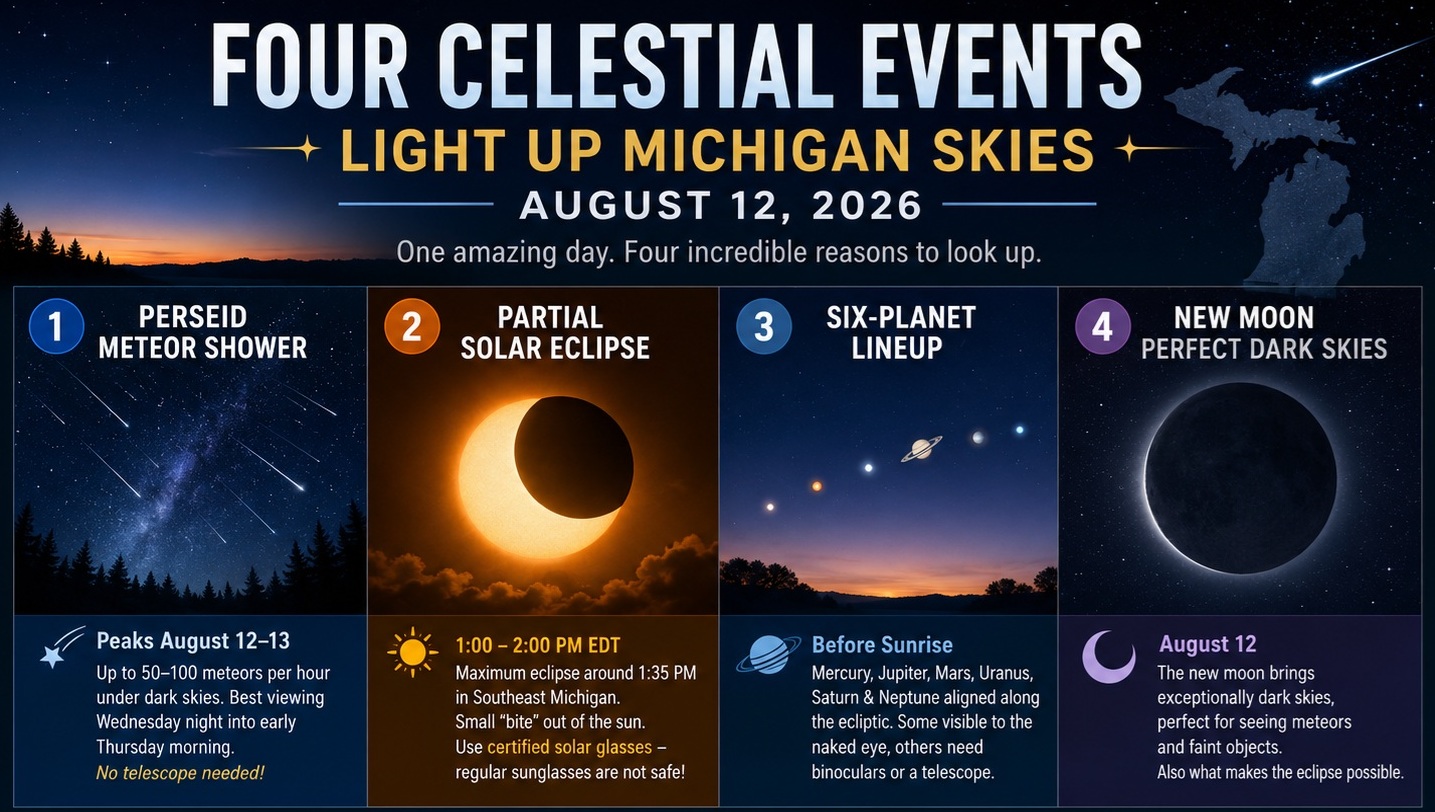
An unusual combination of astronomical events will unfold over the course of the day and night, including the peak of one of the year’s most popular meteor showers, a partial solar eclipse, a lineup of six planets, and a new moon.
While Michigan will not have a front row seat for every part of the celestial spectacle, residents will have opportunities to experience most of it.
Here are the four astronomical events happening on August 12 and what Michigan observers can expect to see.
1. The Perseid Meteor Shower
The biggest attraction for Michigan may come after the sun goes down.
The annual Perseid meteor shower is reaching its peak around August 12 and 13, creating one of the best meteor watching opportunities of the year.
The Perseids occur when Earth passes through debris left behind by Comet Swift Tuttle. Tiny particles enter Earth’s atmosphere at tremendous speeds and burn up, producing the bright streaks commonly called shooting stars.
Under sufficiently dark skies, observers can potentially see dozens of meteors per hour during the shower’s peak. Ideal conditions can sometimes produce rates approaching 50 to 100 meteors per hour, although actual numbers depend heavily on darkness, weather, viewing location, and how much of the sky an observer can see.
This year brings an especially favorable ingredient: virtually no moonlight.
Because the new moon occurs on August 12, there will be no bright moon washing out the night sky. That should make fainter meteors much easier to spot.
For Michigan observers, the best practical viewing opportunity should be Wednesday night, August 12, continuing through the early morning hours of Thursday, August 13.
The later you stay out, generally the better the conditions become. After midnight, Michigan increasingly turns into the direction of the incoming Perseid debris, improving the chances of seeing meteors.
No telescope is necessary.
Find the darkest location possible, allow your eyes approximately 20 to 30 minutes to adjust to the darkness, put away bright phones and flashlights, and look across a large portion of the sky.
2. A Partial Solar Eclipse
Several hours before the Perseids take over the night sky, Michigan will experience another astronomical event.
A solar eclipse occurs on August 12.
Globally, this is a total solar eclipse. The path of totality passes through portions of the Arctic, Greenland, Iceland, and Spain before ending around sunset.
Michigan is well outside the path of totality, but residents can still see a partial solar eclipse.
In Southeast Michigan, including the Detroit and Ann Arbor region, the eclipse should begin shortly after 1 p.m. EDT. Maximum eclipse occurs at approximately 1:35 p.m., with the partial eclipse ending shortly after 2 p.m.
Do not expect anything resembling Michigan’s experience during the April 8, 2024 solar eclipse.
Only a relatively small portion of the sun will be obscured from Southeast Michigan. Rather than dramatically darkening the afternoon sky, the moon will appear to take a small bite out of the sun.
Proper eye protection is essential.
Anyone attempting to observe the eclipse directly must use certified solar viewing glasses or another device specifically designed for observing the sun. Ordinary sunglasses are not sufficient, regardless of how dark they are.
3. Six Planets Line Up in the Morning Sky
Early risers can begin August 12 with another celestial event before the eclipse even starts.
Six planets will be distributed across the morning sky: Mercury, Jupiter, Mars, Uranus, Saturn, and Neptune.
The phenomenon is sometimes described as a planetary parade or planetary alignment.
That description can be slightly misleading. The six planets will not appear packed together in a straight line. Instead, they will be spread across the sky along the ecliptic, the apparent path followed by the sun, moon, and planets.
Michigan observers can participate, although seeing all six planets presents a challenge.
Some of the brighter planets can be observed with the naked eye under appropriate conditions. Mercury can be particularly difficult because of its proximity to the horizon and morning twilight.
Uranus and Neptune are much fainter and generally require binoculars or a telescope.
For casual observers, simply identifying several planets across the morning sky can still make for an impressive start to an unusually active astronomical day.
4. A New Moon Creates Exceptionally Dark Skies
The fourth event is one that observers technically will not see.
August 12 brings a new moon.
During the new moon phase, the moon is positioned approximately between Earth and the sun, with its illuminated side facing away from Earth. As a result, the moon is largely invisible in the nighttime sky.
That apparent absence is excellent news for meteor watchers.
Moonlight is one of the biggest natural obstacles to viewing faint meteors. A full or bright moon can dramatically reduce the number of meteors visible to the naked eye.
With the Perseids peaking around the new moon this year, observers should have unusually dark skies if they can also escape artificial light pollution.
The new moon is also directly connected to the day’s solar eclipse. A solar eclipse can only occur around the new moon phase, when the moon passes between Earth and the sun.
Michigan Can Experience an Entire Day of Astronomy
For Michigan residents willing to start early and stay up late, August 12 offers the possibility of experiencing several different astronomical phenomena within a single day.
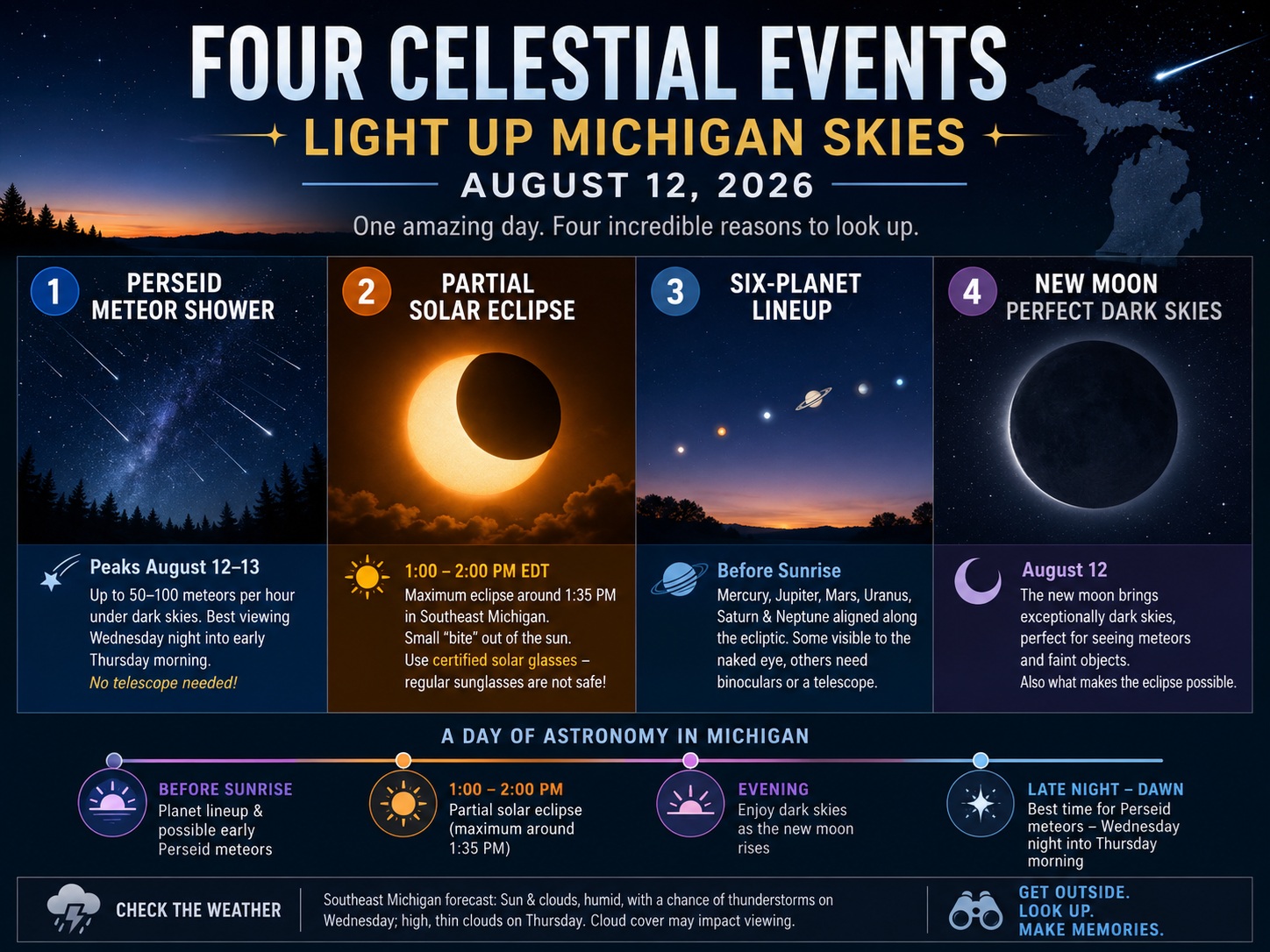
The schedule looks roughly like this:
Before sunrise Wednesday: Look for the planetary lineup and possibly some Perseid meteors.
Around 1 p.m. to 2 p.m. Wednesday: Watch the partial solar eclipse using proper solar viewing protection.
Wednesday evening: Enjoy exceptionally dark skies as the new moon eliminates most natural nighttime light.
Late Wednesday night into early Thursday morning: Head somewhere dark for what should be the best opportunity to watch the Perseid meteor shower.
There is, however, one variable astronomy cannot control: Michigan weather.
The current forecast for Southeast Michigan calls for a mixture of sun and clouds on Wednesday, along with humid conditions and the possibility of thunderstorms. Thursday is currently expected to have high, thin clouds.
Cloud cover Wednesday afternoon could interfere with viewing the partial eclipse, while lingering clouds Wednesday night could affect visibility of the Perseids.
If skies cooperate, however, the Perseids are probably the event worth making the greatest effort to see.
With the meteor shower reaching its peak and essentially no moonlight competing with it, the night of August 12 into the morning of August 13 could provide Michigan with one of its best meteor watching opportunities of 2026.
For anyone willing to drive away from the lights of Detroit and its suburbs, find a dark patch of Michigan sky, and spend an hour looking upward, August 12 could be a memorable night.