

Thanks to DBusiness Magazine for this:
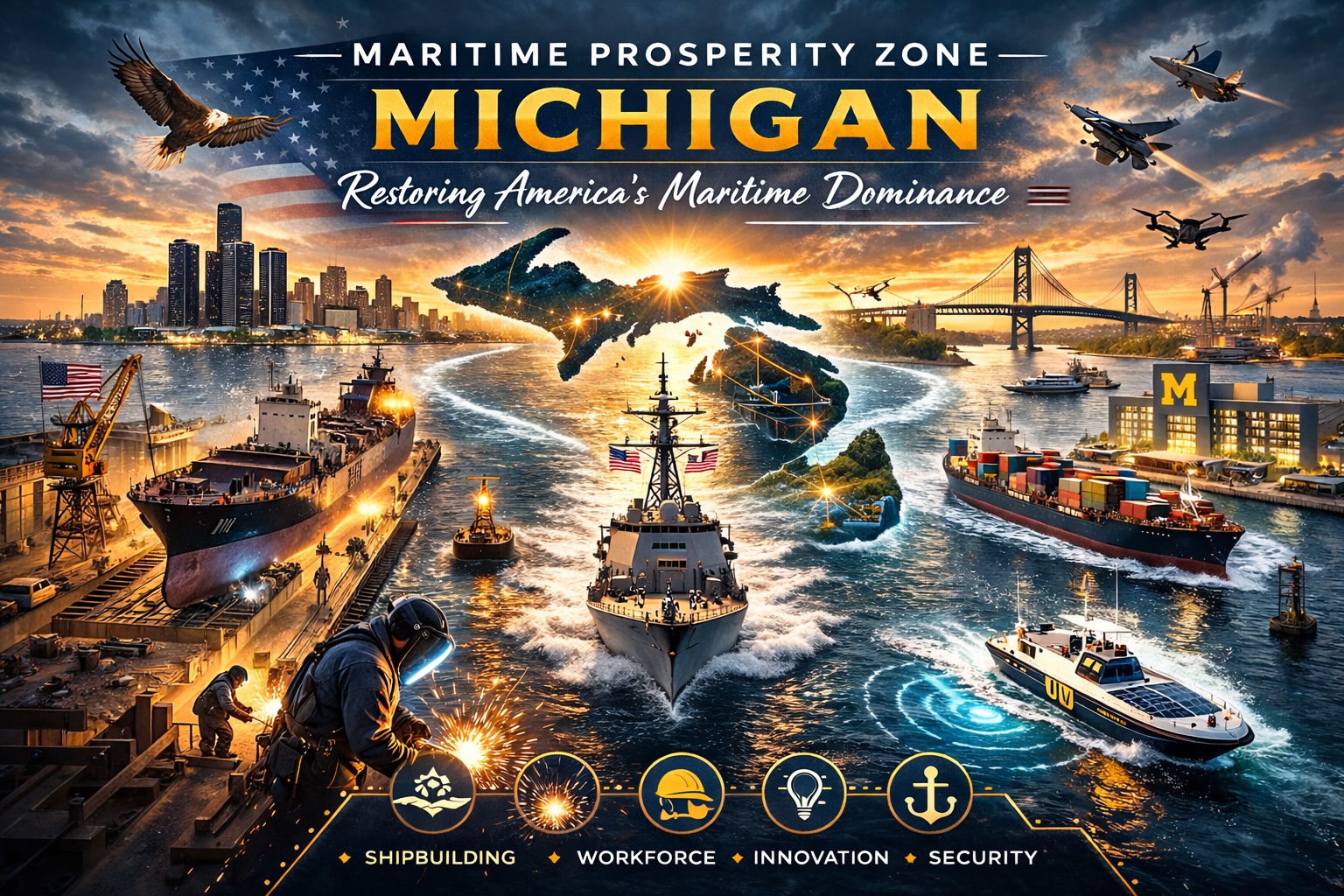
A new coalition in southeast Michigan is aiming to help federal efforts to reinvigorate the nation’s shipbuilding industry with support from more than 30 organizations across four counties.
The coalition includes:
the University of Michigan, the Detroit/Wayne County Port Authority, Newlab, LIFT, and Macomb Community College.
It brings together leaders in the maritime industry, manufacturing, welding, workforce training, and local governments to harness and expand the region’s expertise and infrastructure to advance America’s commercial and military shipbuilding industry.
With 3,200 miles of shoreline, 33 active ports, and a central position along the Great Lakes-St. Lawrence Seaway, Michigan provides a secure inland alternative to traditional coastal shipbuilding regions.
“Southeast Michigan has extensive expertise in its world-class R&D institutions and strong military and commercial manufacturing sector,” says Thomas McKenney, a professor of practice in naval architecture and marine engineering at the University of Michigan, who co-led the formation of the coalition.
“These assets, combined with the region’s industrial capacity, central location, and unique access to inland, deepwater ports position it as one of the nation’s most promising locations for a Maritime Prosperity Zone. A designation here would transform America’s industrial heartland into a vital inland hub for resilient shipbuilding, energy innovation, and maritime security.”
Maritime Prosperity Zones were established by Executive Order in April 2025 to incentivize domestic and allied investment in shipbuilding, maritime manufacturing and port infrastructure. The coalition is advocating to receive the designation. MPZs become top priorities for federal support and private investment to rebuild U.S. shipbuilding.
Michigan, according to officials, is primed to deliver on the opportunity. The state has been developing a statewide maritime strategy under the leadership of McKenney and a $50 million partnership with the U.S. Navy, Department of Defense, and Department of Labor called the Michigan Maritime Manufacturing Initiative. Through the initiative, Macomb Community College has received a $15.4 million investment from the Navy to fast-track a maritime welding and machining program.
The Maritime Prosperity Zone endorsed by coalition supporters encompasses Washtenaw, Monroe, Wayne and Macomb counties, which offer unique geographical, educational and industrial assets that form a robust maritime innovation ecosystem.
Through Lake St. Clair, the Detroit River and Lake Erie, the region provides access to:
- Iron mines and limestone quarries along the upper Great Lakes.
- The St. Lawrence Seaway and Atlantic Ocean.
- The industrial and economic core of Canada, which is collaborating with the U.S. on shipbuilding via the Icebreaker Collaboration Effort.
- Two major ports in Detroit and Monroe that are actively developing new technologies and undergoing major improvements.
The Port of Detroit is collaborating with U-M on advanced fuel technologies — including a barge that could potentially power docked ships with nuclear energy, biofuels or hydrogen rather than from the electric grid.
The Port of Monroe has been receiving upgrades that could make it Michigan’s first port that can manage shipping containers from international, ocean-going trade. It also serves as a real-world testing environment for projects such as Newlab’s prototype autonomous boats for underwater mapping.
“The Port of Detroit has the capacity, expertise and existing collaborations to serve as the perfect springboard for new federally supported projects between academia, industry and local government to advance our nation’s maritime strength,” says Jonathan Kinloch, chair of the Detroit/Wayne County Port Authority.
The R&D and industrial assets that contribute to the region’s maritime leadership include:
The University of Michigan, a national leader in shipbuilding and maritime research. It hosts one of the nation’s largest tanks for testing and designing ships and the nation’s only devoted naval architecture and marine engineering program at a university with very high research output (R1 classification).
Newlab Detroit, a venture platform fostering maritime and logistics solutions, and LIFT, an institute that accelerates the development and adoption of advanced materials and manufacturing processes. These organizations connect academic researchers and startups with commercial partners to prototype new ideas and bring them to scale.
A supply chain network with more than 300 suppliers already used for naval shipbuilding that can be expanded and adapted to support growing commercial maritime manufacturing and repair needs.
“What makes southeast Michigan especially compelling is that its geography and supply chain strength are now intersecting with a new wave of maritime startups looking for places where they can test, deploy and scale,” says Colleen Hau, managing director at Newlab. “A Maritime Prosperity Zone would help convert that early startup momentum into durable commercial activity.”
The region’s colleges and universities provide world-class educational opportunities and a robust workforce spanning from technicians to leaders:
- Macomb Community College trains skilled workers specialized in maritime manufacturing, building up to 200 students graduating each year from their maritime skilled training program.
- U-M naval architecture and marine engineering graduates, totaling more than 1,800 over the past 30 years, including more than 800 doctoral students.
- Avenues for the region’s students to learn from important allies in the Pacific through U-M’s growing educational partnerships with South Korea’s leading university and shipbuilding company.
Restoring America’s Maritime Dominance
https://www.whitehouse.gov/presidential-actions/2025/04/restoring-americas-maritime-dominance/